
Recent News
2026 Outlook for Sodium-Ion Batteries: Growing Development Momentum37/5000 A year-on-year increase of 27%! The cumulative installed capacity of battery energy storage projects worldwide reached 154 GWh in the first seven months of this year.The Global Mining Industry in TurmoilThe “Super Grid Upgrade” project in the UK is facing a significant delay.Up to 40% reduction! New South Wales, Australia has significantly lowered the deployment costs for industrial and residential energy storage.
2026 Outlook for Sodium-Ion Batteries: Growing Development Momentum
October 12, 2026 News8%
The expected proportion of sodium-ion batteries in the deployment of stationary energy storage systems by 2035
273GWh
Expected production capacity of sodium-ion batteries in 2026
69 USD/kWh
Estimated price of sodium-ion cells in 2026 (The price of LFP cells in China is 53 USD/kWh)
As performance improves and manufacturers (especially Chinese enterprises) expand production capacity, global attention to sodium-ion batteries as a substitute for lithium-ion batteries is increasing. Demand is expected to rise from over 1 GWh in 2025 to 257 GWh in 2035, when sodium-ion batteries may account for nearly 10% of the fixed energy storage market. Sodium-ion batteries are unlikely to widely replace lithium-ion batteries, but they can complement lithium-ion batteries in scenarios that prioritize safety, efficiency in cold weather, supply chain diversification, and reducing exposure to the price of scarce lithium resources.
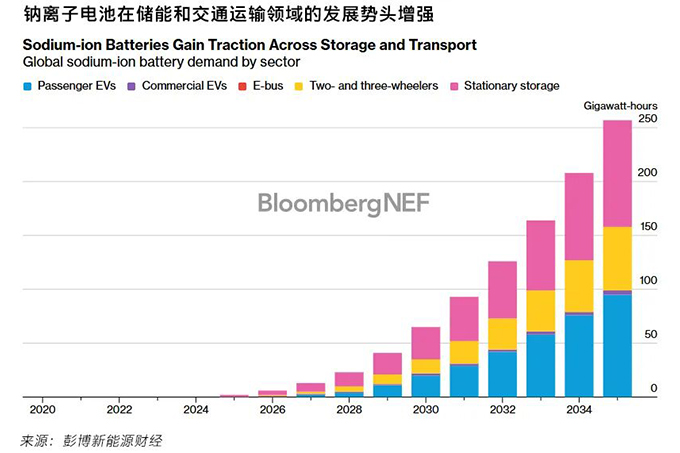
Fixed energy storage is gradually becoming the first major market for sodium-ion batteries. Lower energy density has a smaller impact in fixed applications, and a wider operating temperature range can reduce thermal management requirements. Bloomberg New Energy Finance predicts that by 2035, sodium-ion batteries will account for 8% of fixed energy storage deployments. Although commercial agreements show growing interest in sodium-ion batteries in the United States and Europe, China holds approximately 90% of the total sodium-based project reserves.
The application of sodium-ion batteries in new energy passenger vehicles is limited, but their application in other transportation scenarios may rise. The decline in lithium prices between 2023 and 2025 weakened the cost competitiveness of sodium-ion batteries, and their lower energy density limited their performance. The sales of early sodium-ion battery vehicles in China were relatively small. However, technology is constantly advancing, and their applications in two-wheel and three-wheel vehicles may be more widespread.
With policy support, China has established an early leading edge in the manufacturing, projects, and deployment of sodium-ion batteries. If planned projects are completed on schedule, global sodium-ion battery production capacity may reach 273 GWh in 2026, and 98% of the capacity by 2030 will be located in China. This is approximately 6% of the operating lithium-ion cell capacity, but it is already more than four times the demand for sodium-ion batteries in 2030, indicating a severe production surplus. American and European companies are advancing their system development, but many still rely on the Chinese supply chain.
The price of sodium-ion batteries is still higher than that of lithium iron phosphate (LFP) batteries, and the price of sodium-ion cells has increased in 2026. Bloomberg New Energy Finance estimates that the price of sodium-ion cells in 2026 will be 69 USD/kWh, about 16 USD/kWh higher than that of LFP cells in the Chinese market. The price of sodium-ion turnkey energy storage systems is also higher than that of LFP systems. Bloomberg New Energy Finance predicts that due to the expansion of sodium-ion production capacity and the maturing supply chain, this premium will gradually narrow over time, but the specific time is uncertain.
Research method: This report combines Bloomberg New Energy Finance data, company announcements, and interviews to assess the deployment, technology, and cost relative to lithium-ion batteries of sodium-ion batteries.
RELATED POSTS
-

Ningbo Jing Hong Energy Technology Co., Ltd.
Room 205, 2nd Floor, Building 3, No. 128,Jingyuan Road, Ningbo High-tech Zone,Zhejiang ProvinceA Tech Power B.V.
VAT ID: NL865234759B01
Grevelingenhout 45, 4311NL, Bruinisse, the Netherlands
©2023 wpboss.cn, wordpress theme designer