
Recent News
The Global Mining Industry in TurmoilThe “Super Grid Upgrade” project in the UK is facing a significant delay.Up to 40% reduction! New South Wales, Australia has significantly lowered the deployment costs for industrial and residential energy storage.The US added a record 20.2 GWh of battery storage in just 3 monthsHeatwave expected to remove 15% of France’s nuclear capacity on Friday
International Renewable Energy Agency: The electricity costs of renewable energy + energy storage projects are lower than those of fossil fuels, marking a new stage in the energy transition.
May 18, 2026 NewsAccording to a recent report released by the International Renewable Energy Agency (IRENA), solar power plants and wind power plants have become the cheapest sources of electricity globally. In regions with abundant renewable energy resources, co-located hybrid projects are increasingly achieving round-the-clock continuous power supply, and their costs have reached a level that can compete with fossil fuels.
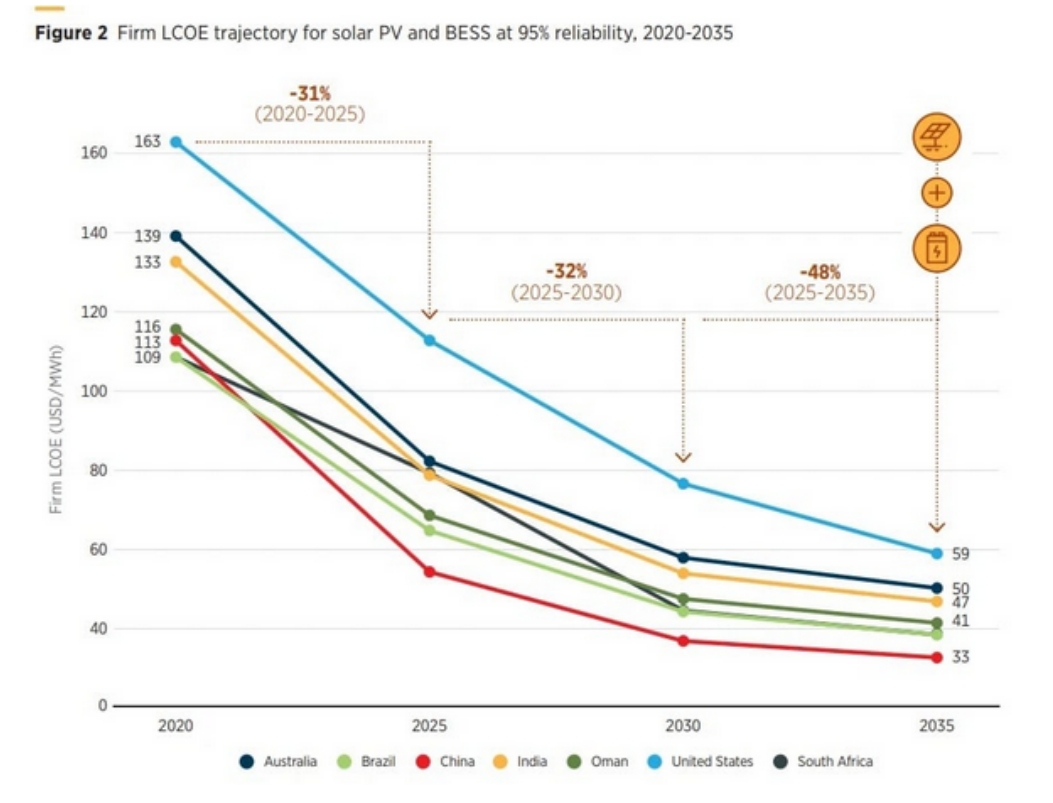
The International Renewable Energy Agency (IRENA) stated in its report that in regions with abundant solar power resources, the "firm levelized cost of electricity" (Firm LCOE) for solar-plus-storage projects has dropped to between $54/MWh and $82/MWh by 2025. It is expected to further fall below $50/MWh by 2035.
In the report titled "Round-the-clock Renewable Energy: The Economics of Stable Operation of Solar and Wind Power Generation", the International Renewable Energy Agency (IRENA) emphasizes that although the scale of renewable energy power plants has expanded rapidly due to cost reduction, the next stage of the energy transition will be defined by the adequacy and flexibility of the power system - ensuring that clean electricity can be provided on demand at any time and in any location.
This report introduces a new project-level indicator - "Stable Levelized Cost of Electricity" (Firm LCOE) - to assess the cost of electricity provided by hybrid deployment energy projects consisting of solar power plants, onshore wind power plants and battery energy storage systems.
The solar energy + energy storage project has achieved cost competitiveness in key areas.
The analysis by the International Renewable Energy Agency (IRENA) indicates that driven by the significant reduction in the costs of solar power plants and battery energy storage systems, the costs of renewable energy generation in all major technologies and markets have been rapidly declining.
In regions with abundant solar energy resources, co-located solar + energy storage projects have already been able to provide electricity at a cost lower than that of fossil fuel power plants. The report states that in 2025, in areas with abundant solar and wind power resources, the stable levelized cost of electricity for solar + energy storage projects will be approximately $54/MWh to $82/MWh, a significant decrease compared to over $100/MWh in 2020.
The International Renewable Energy Agency (IRENA) predicts that costs will continue to decline: by 2030, the stable and standardized levelized cost per kilowatt-hour can drop by approximately 30%, and by 2035, it can decrease by about 40%. Under the best conditions, it will fall below $50/MWh.
The analysis conducted by this institution on 252 utility-scale solar power plants that will be operational in China in 2024 indicates that the vast majority of these projects can provide continuous electricity at a cost lower than $100/MWh. At a 90% reliability level, the stable levelized cost per kilowatt-hour can be as low as $30/MWh; even at a 99% reliability level, the cost only rises to approximately $46/MWh.
From 2010 to 2024, the weighted average total installed cost of global solar power generation decreased by 87% to 708 US dollars per kW; the levelized cost per kilowatt-hour dropped by 90% to as low as 44 US dollars per MWh.
The cost reduction of battery energy storage systems was even more significant, dropping from $2,634/kWh in 2010 to $197/kWh in 2024, a reduction of 93%. The report cited industry data showing that in 2025 alone, the cost of battery energy storage systems dropped by approximately 30%, setting a new historical low record.
The report states that by 2025, the cost per kilowatt-hour for both utility-scale solar power plants and onshore wind power plants worldwide will be approximately $40/MWh, which is less than half of the cost of building new natural gas power plants (over $100/MWh).
In China, the cost per kilowatt-hour of solar energy plus energy storage projects has already been lower than that of newly-built coal-fired power plants and natural gas power plants; while in markets such as Saudi Arabia, even though the fuel costs are relatively low, the price of solar power generation has approached that of natural gas power generation.
The International Renewable Energy Agency (IRENA) also pointed out that in several economies, the co-located wind, solar and energy storage systems are now able to compete with the operating costs of existing fossil fuel power plants – this not only poses a challenge to new fossil fuel power generation, but also raises questions about the continued operation of existing old assets.
The report concludes that the deployment speed of renewable energy power generation facilities will be one of the most crucial factors influencing the global energy transition in the next decade.
RELATED POSTS
-

Ningbo Jing Hong Energy Technology Co., Ltd.
Room 205, 2nd Floor, Building 3, No. 128,Jingyuan Road, Ningbo High-tech Zone,Zhejiang ProvinceA Tech Power B.V.
VAT ID: NL865234759B01
Grevelingenhout 45, 4311NL, Bruinisse, the Netherlands
©2023 wpboss.cn, wordpress theme designer