
Recent News
Up to 40% reduction! New South Wales, Australia has significantly lowered the deployment costs for industrial and residential energy storage.The US added a record 20.2 GWh of battery storage in just 3 monthsHeatwave expected to remove 15% of France’s nuclear capacity on Friday“European Battery Storage Market Outlook 2026-2030”: Utility-scale systems drive the rapid development of the battery storage marketAustralia will add 9.1 GW of power generation facilities and energy storage systems in the fiscal year 2026, with energy storage systems taking the dominant position.
Up to 40% reduction! New South Wales, Australia has significantly lowered the deployment costs for industrial and residential energy storage.
September 14, 2026 NewsRecently, the state of New South Wales (NSW) in Australia has launched a new prepaid discount program, offering one-time cost reductions for battery energy storage systems installed by small businesses and households. Depending on the size of the battery energy storage system, the installation cost can be reduced by approximately 20% to 40%.
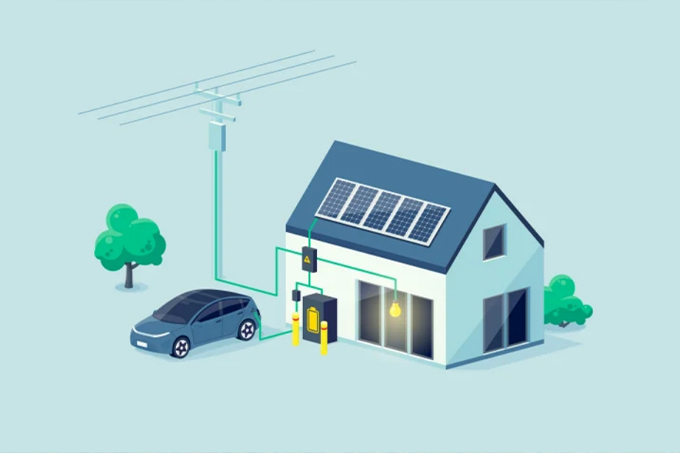
Starting from September 1, 2026, eligible industrial and commercial users can enjoy this discount through government-certified suppliers, with the discount amount increasing as the size of the battery energy storage system increases. NSW (the government provides an example: a small grocery store can receive approximately 37,000 Australian dollars (about 24,050 US dollars) in reduction, while medium-sized enterprises (such as dairy farms) are expected to receive approximately 355,000 Australian dollars.
This program covers battery energy storage systems ranging from 20 kWh to 30,000 kWh and extends to apartment buildings with four or more units. The owners’ committee can apply for discounts for 20 kWh to 200 kWh battery energy storage systems installed in public areas.
The NSW government stated that the new incentive measures can be used in conjunction with the discount plan provided by the Australian federal government for rooftop solar power installations in commercial buildings. In addition, the existing virtual power plant (VPP) incentive scope has also been expanded to include battery energy storage systems of 50 kWh and below, enabling small businesses and household users to receive a maximum subsidy of 1,000 Australian dollars when participating in grid peak demand response.
In June 2025, the VPP incentive for households in NSW doubled, reaching up to 1,500 Australian dollars. The NSW government stated that if both the federal discount and the state-level incentive are applicable, a typical 11.5 kWh residential battery energy storage system can receive nearly 5,000 Australian dollars in support. This expansion of the incentive scope means that more small businesses can enjoy the same grid connection support subsidy as household users.
The NSW government pointed out that the installation of residential battery energy storage systems in the state has continued to grow rapidly, with approximately 10,000 units added each month.
Based on the federal residential energy storage policy, NSW has intensified its efforts in the non-residential sector.
The launch of this program comes at a time when the “Home Battery Discount Program” launched by the Australian federal government is continuously expanding. As of now, more than 507,000 households, small businesses, and community organizations have installed battery energy storage systems through this program – this program is managed by the Australian Clean Energy Regulator and provides a 30% prepaid cost discount for small energy storage systems deployed in conjunction with solar power facilities.
This budget of 720 million Australian dollars (for a four-year period) has been steadily advancing since its launch in July 2025, and as of May 2026, it has cumulatively installed over 400,000 residential battery energy storage systems, with a total installed capacity of over 112 GWh, exceeding the expectations of the Australian federal government. This program originated from the successful re-election of the Australian Labor Party in the 2025 federal election and has always been a core pillar of its energy policy platform.
Before and after the launch of this program, Tim Buckley, the president of the think tank Climate Energy Finance, stated that this program could make Australia a highly sought-after battery energy storage market and predicted that it would help establish local supply chains and stimulate broader investment. Buckley specifically pointed out that the Australian federal subsidy is designed to be combined with the state-level plan – he cited an earlier battery subsidy program in NSW that provided up to 2,400 Australian dollars of additional support and a later measure in Western Australia that expanded to provide a refund of up to 7,500 Australian dollars to some customers.
This new discount program in New South Wales for commercial and apartment buildings extends this “overlay” principle to non-residential and shared building scenarios – areas that were not directly covered by the federal plan (which mainly targeted small residential energy storage systems).
Unlike the federal plan, which focuses on individual households, the discount in New South Wales is explicitly targeted at businesses, industrial operators, and multi-family buildings. These sectors have not yet been the primary focus of the Australian federal subsidy design. The New South Wales government defines enterprises installing battery energy storage systems ranging from 20kWh to 50kWh as suitable for small businesses such as restaurants, takeout shops, and convenience stores, with a scale between typical household systems and those installed in multi-unit apartment buildings or large commercial projects. By extending the virtual power plant (VPP) incentives to this market, the state government also hopes to attract more small commercial battery energy storage systems to participate in grid ancillary services, a previous arrangement that was mainly limited to residential energy storage systems.
The New South Wales government stated that the series of discounts for commercial and apartment buildings are part of its broader energy efficiency incentives for businesses; at the same time, household users are also continuing to enjoy cost-of-living assistance. Under the joint promotion of federal and state-level plans, the residential and commercial battery energy storage market in New South Wales is continuously expanding.
RELATED POSTS
-

Ningbo Jing Hong Energy Technology Co., Ltd.
Room 205, 2nd Floor, Building 3, No. 128,Jingyuan Road, Ningbo High-tech Zone,Zhejiang ProvinceA Tech Power B.V.
VAT ID: NL865234759B01
Grevelingenhout 45, 4311NL, Bruinisse, the Netherlands
©2023 wpboss.cn, wordpress theme designer