
Recent News
The global cost of storing one kilowatt-hour of electricity for four hours (LCOE) is lower than that of gas peak shaving. The energy economic landscape has witnessed a structural shift.Rooted in the core heartland of Central Asia, how can Chinese enterprises tap into the market of Uzbekistan?2026 Outlook for Sodium-Ion Batteries: Growing Development Momentum37/5000 A year-on-year increase of 27%! The cumulative installed capacity of battery energy storage projects worldwide reached 154 GWh in the first seven months of this year.The Global Mining Industry in Turmoil
The global cost of storing one kilowatt-hour of electricity for four hours (LCOE) is lower than that of gas peak shaving. The energy economic landscape has witnessed a structural shift.
October 27, 2026 NewsThere is a shortage of gas turbine supplies, and the rising fuel prices have pushed up the costs of traditional power sources; the large-scale iteration of energy storage manufacturing has continuously lowered the system prices.
The latest "Global Levelized Cost of Electricity (LCOE) Report" by Wood Mackenzie shows that technological progress and changes in market patterns have driven the cost trends of various power sources to diverge; in all 43 comparable markets, the cost of four-hour energy storage systems has already been lower than that of open-cycle gas turbines.
In the Middle East and Africa region, the average cost of photovoltaic power is as low as 37 US dollars per megawatt-hour, the lowest in the world; it is expected that by 2035, the cost of four-hour energy storage will further decrease by 33% to 80 US dollars per megawatt-hour, completely replacing gas units as the most economical peak-shaving power source in the region. China continues to maintain the global benchmark position for energy storage costs, with a level that is more than 55% lower than the average level in other regions in Asia-Pacific, highlighting the effect of manufacturing scale reshaping the global energy cost landscape.
This economic advantage has been established and the gap is still continuously widening. The shortage of gas equipment supplies and the fluctuation of fuel prices have pushed up the peak-shaving costs; while the scale effect of the energy storage industry continues to be released, the cost curve is steadily declining.
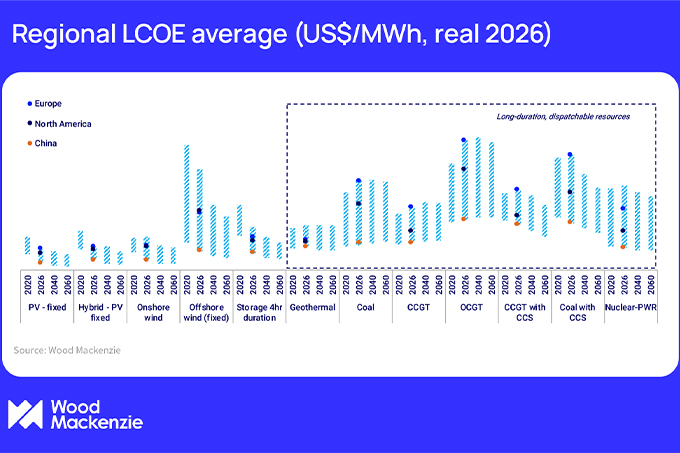
Shaping of base-load power supply pattern, photovoltaic becomes the preferred option
Single-axis tracking photovoltaic has become the lowest-cost new power source in 43 out of 48 comparable markets, and onshore wind power remains leading in the remaining 5 markets. In regions with abundant resources such as Saudi Arabia and the United Arab Emirates, the cost of photovoltaic power per kilowatt-hour is expected to drop below 20 US dollars by 2033.
Market analysis of each Region

Latin America Region
In 2026, single-axis tracking photovoltaic systems will remain the lowest-cost power source in the region. It is projected that the overall cost will further decrease by 38% by 2060. Brazil, Chile, and Mexico have long-term cost advantages due to their favorable light conditions and high utilization efficiency. The cost of onshore wind power has been rapidly declining: Chinese OEMs have entered the market, leading to intensified competition and the large-scale production of wind turbines, which will reduce the regional average wind power cost from $73 per megawatt-hour to $58 per megawatt-hour by 2030, a reduction of nearly 21%.
The policy for energy storage support has promoted the expansion of installations, and it is expected that the cumulative cost will decrease by 42% by 2060. Offshore wind power is still in its early stage of development. It is expected that it will only be able to match the cost of combined-cycle gas turbines in the early 2040s; Brazil and Colombia have already initiated the construction of local supply chains.
The Asia-Pacific Region
Large-scale photovoltaic power remains the most cost-competitive power source in the Asia-Pacific region, but there is a significant gap between different markets: the cost difference between the highest and lowest markets in 2026 is more than twice, and it is expected to expand to more than 2.5 times by 2030. The competitiveness of onshore wind power continues to improve, with a cost gap of up to 6 times within the region; Chinese equipment manufacturers' promotion of high-efficiency models will significantly narrow the cost gap between wind power and coal power in South Asia and Southeast Asia.
China maintains a global lead in energy storage costs, with the levelized cost being more than 55% lower than the average of other regions in the Asia-Pacific (134 US dollars per megawatt-hour); it is expected that by 2036, the regional average cost will be reduced to 92 US dollars per megawatt-hour due to China's supply chain advantages, while Japan, Australia, the Philippines, and other countries affected by tariffs, construction costs, and local manufacturing policies will still have higher prices. Overseas offshore wind power costs are under short-term pressure, but they are expected to significantly decline after the supply chain matures and the single-unit capacity increases in the early 2030s.
European Region
Although the price of photovoltaic modules rose in 2026, leading to an increase of 14% in the initial investment, photovoltaic remains the lowest-cost power source in the European region. It is expected that the cost of fixed-structure photovoltaic will decrease by 22% by 2060. Wind power equipment manufacturers are optimizing their cost structure, with the annual investment dropping by 2.5% before 2030; after 2030, efficiency improvement becomes the core driver, and it is expected that the cost will drop to 60 US dollars per megawatt-hour by 2060.
Investment in energy storage systems has rebounded for the first time in three years. The price of battery cells has rebounded by approximately 10% compared to the low point in 2025. It is expected that overall investment will decrease by 12% before 2031, and the increase in lithium prices after 2029 will slow down the cost reduction pace. The cost of fossil energy in Europe is the highest globally. It is expected that the cost of carbon emissions will exceed the cost of fuel by 2030; offshore wind power is expected to steadily reduce prices from the 2030s as the supply chain improves.
North America Region
Tariffs and trade restrictions increase the cost of photovoltaic power, with distributed projects being the most affected; utility-scale projects benefit from the approved reserve capacity (168 gigawatts) and are expected to see an average annual increase of about 5% in component prices; residential and commercial projects face greater pressure, with prices continuing to rise from 2027 to 2028. The long-term cost decline trend of wind power is clear, with a cumulative reduction of approximately 16% by 2060.
Tax credit policies offset supply chain constraints and support the development of energy storage; the preferential exit in 2038 may cause short-term fluctuations, while long-term technological iteration and local capacity construction will drive a 10% cost reduction by 2060. The growth in data center electricity consumption drives the installation demand, and the supply of natural gas is tightening, further highlighting the long-term economic viability of renewable energy and energy storage.
Middle East and Africa Region
In 2026, the cost of renewable energy worldwide will be the lowest, with photovoltaic leading the price benchmark. Monocrystalline tracking photovoltaic has an average cost of 37 US dollars per megawatt-hour, and will drop to 24 US dollars per megawatt-hour by 2035, with Saudi Arabia and the United Arab Emirates expected to be below 20 US dollars per megawatt-hour. The entry of Chinese wind power equipment has driven cost improvement, and Egypt and Morocco have utilization efficiencies of 40%–45%, highlighting the economic viability of wind power.
Energy storage costs have achieved a structural breakthrough: four-hour energy storage will be 120 US dollars per megawatt-hour in 2026 and 80 US dollars per megawatt-hour by 2035, fully replacing open-cycle gas turbines to undertake peak load functions, marking a fundamental change in the logic of regional power planning.
The core of the transformation is no longer just the competitiveness of renewable energy, but the synergy of energy storage and photovoltaic is redefining the economic operation mode of the power system. From Latin America to Asia-Pacific, the cost reduction of energy storage, combined with the development of high-quality resources, has continuously weakened the economic rationality of new gas peak-load projects; long-term agreements support renewable energy, which is no longer just the cost baseline, but also the price ceiling.
RELATED POSTS
-

Ningbo Jing Hong Energy Technology Co., Ltd.
Room 205, 2nd Floor, Building 3, No. 128,Jingyuan Road, Ningbo High-tech Zone,Zhejiang ProvinceA Tech Power B.V.
VAT ID: NL865234759B01
Grevelingenhout 45, 4311NL, Bruinisse, the Netherlands
©2023 wpboss.cn, wordpress theme designer